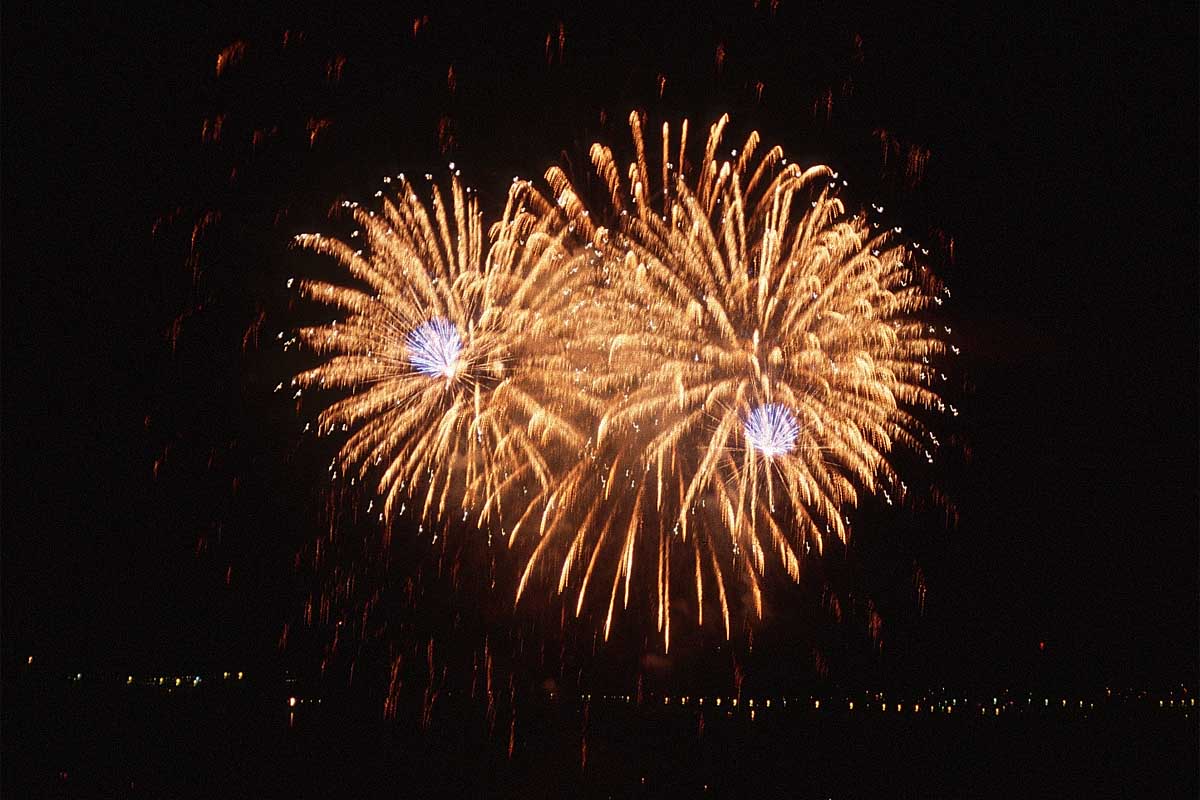
How to Shoot Fireworks Photos on July Fourth


Firefighters and explosive experts will tell you that shooting fireworks can be a dangerous activity that only should be done under the supervision of professionals.
Emergency room workers will tell you that those experts are correct.
There is another way to shoot fireworks and be safe at the same time: Use your digital camera to shoot fireworks photos. Fireworks photography can be an enjoyable hobby for beginning and intermediate photographers that lends itself to amazing images of Fourth of July celebrations or other occasions with fireworks.
Here are a dozen fireworks photography tips that can help you shoot some amazing photos during Independence Day celebrations.
Equipment. Make sure you have everything you need, including extra memory cards, extra batteries, and tripods. Chances are good you'll have to park a vehicle far from where you shoot your fireworks photos, so plan ahead to make sure you have the needed equipment. Also, bring a small flashlight or penlight to help you make changes to the settings on your camera in the dark.
Location. Determining the best location to shoot fireworks photos is an often overlooked aspect of fireworks photography. Obviously, you need to find a location that is free of trees, tall buildings, and overhanging wires that could ruin your photo. However, you also should make sure the wind is at your back as you face the fireworks show. Then, the wind will carry any smoke away from you, giving your camera a clear shot of the fireworks. Try to pick a spot well away from other people, thereby avoiding having a stray head or somebody walking in your shot.
Location, again. Many large fireworks shows take place near historical buildings or other well-known landmarks. If you can frame your fireworks photos with these landmarks in the background of the shot, you may end up with a more interesting photo.
Fill flash. If you want to include some family members in the foreground of your fireworks photos, try firing a fill flash that will illuminate the people near the camera while capturing the fireworks in the background. It can be tricky to time the shutter speed with this technique, so you may want to try several shots at different shutter speeds to find a good shot. Otherwise, make sure the flash is turned off.
Go manual. Most fully automatic, point and shoot cameras rarely capture good shots of fireworks. Such cameras simply cannot set the exposure and shutter speed correctly because of the random nature of when the fireworks appear in the sky and because the light from the fireworks is very bright and doesn't last long. Some point and shoot cameras have a fireworks option in the scene modes, which may create a few good photos. However, the most reliable option is to manually control the shutter speed and exposure. With a manual focus camera, be sure to set the focus to infinity.
High quality. Make sure you set your camera to the highest-quality settings possible. Use plenty of resolution with fireworks photos.
Use low ISO settings. Because of the intensity of the light in a fireworks burst, it's best to use a low ISO setting that will limit the light striking the image sensor. Something between ISO 50 and ISO 200 usually is best, but you'll have to adjust the ISO setting manually.
Be steady. Always use a tripod to shoot fireworks photos. Because of the slow shutter speeds required to capture fireworks, such shots are especially susceptible to camera shake, which leads to blurry photos. Even the image stabilization features built into many new cameras cannot overcome the problem from camera shake with a slow shutter speed. Only a tripod can hold the camera steady enough.
Timing. When trying to time a fireworks burst for the best exposure, you might need some trial and error. However, it usually works best to open the shutter when you hear the shell launch into the air. Try to keep the shutter open for the entire burst. However, this can be tricky if several bursts are occurring simultaneously, which can interfere with the original burst that you're trying to capture. Try a few different techniques to determine what works best during a particular fireworks show.
Fully open shutter. One trick you can use is to open the shutter fully (by setting the shutter speed to "bulb") and place a piece of black cardboard over the lens to block all external light. Then remove the cardboard when you want to expose the photo and return the cardboard when you want to stop the exposure. If you do this several times, you can capture multiple fireworks bursts in one frame. Once you have the number of bursts you want, close the shutter. Just be careful not to bump the camera when moving the piece of cardboard.
Use a remote. If you have a remote or a cable release you can use to fire the shutter, it will greatly minimize the chances that you will bump the camera and ruin a shot by bumping the camera on the tripod.
Hope for some luck. With fireworks photography, luck plays a role. With a large fireworks show, you never quite know what a particular burst will look like ahead of time, and it could appear anywhere in the sky. Try a variety of shutter speeds and exposure settings, to give yourself the best chance of capturing some high quality photos.

Fireworks Photography Tips


The spectacle of fireworks attracts millions of spectators annually. Just recently my 3 year old daughter was asking to go see fireworks. Her prior viewing was over 11 months ago and apparently made a big impression on her then-2-year-old mind! Those of us with love for photography running deep desire to capture everything of beauty we come upon. Fireworks definitely fit that description. The good news is that fireworks photography is easy. Following are some tips to make your fireworks photography successful. Start with a solid tripod. If your camera is not motionless during the rather long exposures necessary for fireworks photography, the smooth paths of light the fireworks create will appear jagged. Mount your camera on a tripod and carefully level it. I generally like a portrait/vertical orientation (vs. landscape/horizontal orientation), but that is personal preference and is greatly influenced by additional subjects framed in the picture. Fireworks launched simultaneously from multiple locations also work well with a landscape orientation. Also important is a remote release for the camera. Again, you want the camera to be motionless during the exposure. Most camera lenses will work well as long as they are the right focal length or focal length range. Most camera lenses provide very good optical quality at f/8 through f/16, the apertures most used for fireworks photography. If you are not sure what focal length you need, take a couple of lenses. Zoom lenses provide the most flexibility if you are not sure of your viewing distance or focal length requirements. A scouting trip prior to the event will (as always) prove valuable. All fireworks events take place after dark. Working in the dark is challenging even when you are intimately familiar with your equipment. A small issue such as dropping a memory card can turn into a frustrating problem. Pack a small flashlight. Show up early for the fireworks event. Make sure your location has a clear line of site and that late arriving viewers cannot obstruct your view. You might setup your equipment behind your blanket to help keep the view clear. At the same time, treat others with consideration. Be sure the background is pleasant. Remember that street and other lights will become overexposed blobs that require post-processing to remove. Setting up in the daylight is easier than in the dark. Leveling the camera, setting manual focus and getting the proper framing is difficult against a dark sky. Framing may need to be tweaked after the action starts - but take a guess. Get all of these tasks out of the way before complete darkness. I generally use manual everything for fireworks photography: manual exposure, manual focus ... As I mentioned previously, I like to setup my manual focus setting prior to dark. Pick a subject that is a similar distance as the fireworks will be. Since I often start my exposures with a dark sky over all focus points, autofocus does not work. Since a narrow aperture is used at a generally long distance, a wide depth of field usually covers any manual focus errors. Be careful to not bump the focus ring after the action starts. Also remember that changing focal length changes focusing in some zoom lenses. Check your lens for this attribute before dark. As a focus alternative, you can focus on the first burst that is fired. For a shutter speed, Bulb is often best. I like to press the remote shutter release as a rocket is launching and hold it open until the firework completely fades from its explosion. This is generally 2 to 10 seconds. Missed the rockets on the first blast? You might be able to include the next set of rockets in the same exposure. Because the fireworks are constantly and rapidly moving, keeping the shutter open for long periods of time does not affect the exposure. Exposure is based on the aperture and ISO settings used. If there are subjects in addition to the fireworks included in the photo that are lit by a constant light, a specific shutter speed may be required. You may think that a fast aperture would be helpful since you are shooting in the dark, but you are actually shooting bright light. The best aperture is usually between a narrow f/8 and an even narrower f/16. The exact setting is somewhat dependent on the distance of the fireworks (light fall-off, air clarity). Using an aperture narrower than f/16 will result in soft (not sharp) images as diffraction becomes an issue. Watch your histogram - keep the brightest pixels close to the right of the graph but not overexposed (stacked on the right side of the histogram). I generally use ISO 100 for the lowest noise levels possible. Quickly analyze the first photograph you can capture. How does the histogram read? Is the framing correct? Remember that you can crop later - but building missing sections of bursts is very complicated and time consuming. Is the image sharp? Make any adjustments necessary until you have it perfected. Then concentrate on the action. Long shows will require lots of memory capacity - be prepared - Have spare cards pre-formatted. Make spot checks periodically to make sure no settings have changed. Avoid too many bursts in one fireworks photo. In my opinion, the overexposed areas created by repeated rockets and bursts make a fireworks photo look unattractive in addition to looking too busy. The finale may be the worst time to photograph fireworks. Your opinion may be different - and photography has no rules. Be creative. For added impact, get additional subjects in your fireworks photos. Large buildings look great in fireworks pictures. Lakes and rivers create beautiful reflections. Adding a person or persons to the photo adds interest. A flash will be of no use in lighting the fireworks, but can be useful in lighting a foreground subject watching the fireworks. Try lighting foreground subjects with your flashlight. You will probably want to focus on foreground subjects instead of the fireworks for these shots. Again, be creative! Creativity doesn't need to end with the shot. The black sky background in fireworks photos makes it easy to add other fireworks blasts or other items (such as a moon) to your images in Photoshop. Try replacing the complete black background with your country's flag. Fireworks photography is not hard. Getting a great looking fireworks photograph just requires a little planning and simple execution. You will be adding impressive shots to your collection in no time.

How to Photograph Fireworks Displays


Do you want to know how to photograph fireworks? With 4th July just days away I thought I’d refresh this article in which I give 10 Fireworks Photography tips to help you get started.
Fireworks Displays are something that evoke a lot of emotion in people as they are not only beautiful and spectacular to watch but they also are often used to celebrate momentous occasions.
I’ve had many emails from readers asking how to photograph fireworks displays, quite a few of whom have expressed concern that they might just be too hard to really photograph. My response is always the same – ‘give it a go – you might be surprised at what you end up with’.
My reason for this advice is that back when I bought my first ever SLR (a film one) one of the first things I photographed was fireworks and I was amazed by how easy it was and how spectacular the results were. I think it’s even easier with a digital camera as you can get immediate feedback as to whether the shots you’ve taken are good or not and then make adjustments.
Of course it’s not just a matter of going out finding a fireworks display – there are, as usual, things you can do to improve your results. With 4 July just around the corner I thought I’d share a few fireworks digital photography tips:Read more: http://www.digital-photography-school.com/how-to-photograph-fireworks#ixzz0yiCfPIY4
1. Use a Tripod

Perhaps the most important tip is to secure your digital camera to something that will ensure it doesn’t move during the taking of your shots. This is especially important in photographing fireworks simply because you’ll be using longer shutter speeds which will not only capture the movement of the fireworks but any movement of the camera itself. The best way to keep your camera still is with a tripod (read our series on tripods and how to use and buy them). Alternatively – keep in mind that there are other non Tripod options for beating camera shake.
2. Remote Release
One way to ensure your camera is completely still during fireworks shots is to invest in a remote release device. These will vary from camera to camera but most have some sort of accessory made for them. The other way of taking shots without touching your camera is to use the self timer. This can work but you really need to be able to anticipate shots well and its very very hit and miss (read more on remote shutter releases).
3. Framing Your Shot
One of the most difficult parts of photographing fireworks is working out where to aim your camera. The challenge you’ll face in doing this is that you generally need to aim your camera before the fireworks that you’ll be photographing goes off – anticipation is key. Here are a few points on getting your framing right.
Photo by Stuck in Customs
Scope out the location early – Planning is important with fireworks and getting to the location early in order to get a good, unobstructed position is important. Think about what is in the foreground and background of your shots and make sure you won’t have people’s heads bobbing up into your shots (also consider what impact you’ll have on others around you also). Take note of where fireworks are being set up and what parts of the sky they are likely to be shot into – you might also want to try to ask some of those setting up the display for a little information on what they are planning. Also consider what focal lengths you might want to use and choose appropriate lenses at this time (rather than in the middle of the show).
Watch your Horizons - One thing that you should always consider when lining up fireworks shots is whether your camera is even or straight in it’s framing. This is especially important if you’re going to shooting with a wide focal length and will get other background elements in your shots (ie a cityscape). Keeping horizons straight is something we covered previously on this site and is important in fireworks shots also. As you get your camera on your tripod make sure it’s level right from the time you set up.
Vertical or Horizontal? – There are two main ways of framing shots in all types of photography, vertically (portrait) or horizontally (landscape). Both can work in fireworks photography but I personally find a vertical perspective is better – particularly as there is a lot of vertical motion in fireworks. Horizontal shots can work if you’re going for more of a landscape shot with a wider focal length of if you’re wanting to capture multiple bursts of fireworks in the one shot – but I don’t tend to go there that often.
Remember your framing – I find that when I photograph fireworks that I spend less time looking in my viewfinder and more looking at the sky directly. As a result it’s important to remember what framing you have and to watch that segment of the sky. Doing this will also help you to anticipate the right time for a shot as you’ll see the light trails of unexploded rockets shooting into the sky.
4. Focal Length?

One of the hardest parts of photographing fireworks is having your camera trained on the right part of the sky at the right time. This is especially difficult if you’re shooting with a longer focal length and are trying to take more tightly cropped shots. I generally shoot at a wider focal length than a tight one but during a show will try a few tighter shots (I usually use a zoom lens to give me this option) to see if I can get lucky with them. Of course zoomed in shots like the one to the left can be quite effective also. They enable you to really fill the frame with great color. Keep in mind however that cropping of your wider angle fireworks shots can always be done later to get a similar impact in your photography.
5. Aperture

A common question around photographing fireworks displays is what aperture to use. Many people think you need a fast lens to get them but in reality it’s quite the opposite as the light that the fireworks emit is quite bright. I find that apertures in the mid to small range tend to work reasonably well and would usually shoot somewhere between f/8 to f/16.
6. Shutter Speed

Probably more important to get right than aperture is shutter speed. Fireworks move and as a result the best photographs of them capture this movement meaning you need a nice long exposure. The technique that I developed when I first photographed fireworks was to shoot in ‘bulb’ mode. This is a mode that allows you to keep the shutter open for as long as you hold down the shutter (preferably using a remote shutter release of some type). Using this technique you hit the shutter as the firework is about to explode and hold it down until it’s finished exploding (generally a few seconds).
You can also experiment with set shutter speeds to see what impact it will have but I find that unless you’re holding the shutter open for very long exposures that the bulb technique works pretty well.
Don’t keep your shutter open too long. The temptation is to think that because it’s dark that you can leave it open as long as you like. The problem with this is that fireworks are bright and it doesn’t take too much to over expose them, especially if your shutter is open for multiple bursts in the one area of the sky. By all means experiment with multiple burst shots – but most people end up finding that the simpler one burst shots can be best.
7. ISO
Shooting at a low ISO is preferable to ensure the cleanest shots possible. Stick to ISO 100 and you should be fine.
8. Switch off your Flash

Shooting with a flash will have no impact upon your shots except to trick your camera into thinking it needs a short exposure time. Keep in mind that your camera’s flash will only have a reach of a few meters and in the case of fireworks even if they were this close a flash wouldn’t really have anything to light except for some smoke which would distract from the real action (the flashing lights).
9. Shoot in Manual Mode
I find I get the best results when shooting in manual exposure and manual focus modes. Auto focusing in low light can be very difficult for many cameras and you’ll end up missing a lot of shots. Once your focusing is set you’ll find you don’t really need to change it during the fireworks display – especially if you’re using a small aperture which increases depth of field. Keep in mind that changing focal lengths will mean you need to need to adjust your focusing on most lenses.
10. Experiment and Track Results

Throughout the fireworks display periodically check your results. I generally will take a few shots at the start and do a quick check to see that they are OK before shooting any more. Don’t check after every shot once you’ve got things set up OK (or you’ll miss the action) but do monitor yours shots occasionally to ensure you’re not taking a completely bad batch.
Also experiment with taking shots that include a wider perspective, silhouettes and people around you watching the display. Having your camera pointed at the sky can get you some wonderful shots but sometimes if you look for different perspectives you can get a few shots that are a little less cliche and just as spectacular. Most of the best shots that I’ve seen in the researching of this article have included some other element than the fireworks themselves – whether it be people, buildings, landmarks or wider cityscape perspectives.

Fireworks


Fireworks

It is generally recognized that fireworks originated in China during the Sung dynasty (960-1279). A cook in ancient China discovered that a mixture of sulphur, saltpetre, and charcoal was highly flammable and would explode if confined in a small space. This discovery was first used for entertainment. The technique was soon adapted to weaponry and used to shoot rocket-powered arrows. In the 7th century the knowledge spread west via Arabia, reaching Europe in the 13th century where pyrotechnics developed with the invention of the gun in the 14th century. It was not until the 19th century that fireworks became as vividly colourful as we know them today. Brilliant colours are achieved by combining potassium chlorate and various metallic salts. These salts produce a variety of colours: strontium burns red; copper makes blue; barium glows green; and sodium produces yellow. Magnesium, aluminium and titanium give off white sparkles or a flash. Every firework show is a fantastic display of physics. The pyrotechnist has to take into account the relationships between vectors, velocities, projectiles and their trajectories together with the explosion forces behind burst patterns.


How to Shoot Brilliant Fireworks Photos

Fireworks closeup photoAs I was surfing the web today, I came across several questions (throughout the various photography forums which I like to visit) regarding "how to shoot fireworks photos." Although I came across a lot of good information, there were bits and pieces scattered about, and since I myself have had (what I consider to be) success in shooting fireworks, I thought I would share these helpful tips for those of you who will be bringing your cameras along to the Fourth of July celebrations.

First and foremost, the single most important thing you need to have when shooting fireworks is a tripod. Whether you are shooting with a point and shoot camera, or a fancy digital SLR, you simply won't be able to hold the camera steady enough by hand due to the relatively long exposure times required in fireworks photography. Tripods are a MUST! With that being said, you should also remember that if you are planning on brining a tripod to an event such as the Fourth of July (or any fireworks celebrations for that matter), there are bound to be plenty of people all trying to claim enough space to stand or sit comfortably, so you'll want to go a little early to set up your tripod before the crowds arrive.

When shooting fireworks, you'll achieve great results if you shoot with a fairly long exposure time. If you are using a point and shoot digital camera, most of them have a dedicated "fireworks" mode or setting. If you are shooting with a digital SLR, you'll want to use anywhere from a 4-5 second exposure, shooting at an aperture of f11 or even f16. One of the best tools to have with you (in addition to your tripod) would be a shutter release cable. That way, you can set up the initial framing of your shots, and control the shutter while still getting to watch those beautiful fireworks. Also, a shutter release cable would be especially userful if you want to use your camera's bulb mode to capture even longer exposures.

Another experiment you can do, is to set your aperture very small, say at f22 or even f32, and shoot with an exposure time of 20-30 seconds. You'll be able to catch several fireworks in the frame, and the results can be outstanding!

In framing your shots, it will all depend on the type of photos you are after. If you like the closeup and tight shots of the fireworks blast as in the above image, you will want to bring a zoom lens which can go to at least 200mm. That will allow your camera to get up close and personal with those fireworks. If you prefer to capture the fireworks in a landscape or "entire scene" view, bring a nice wide angle lens. Here's a look at what a wide angle lens would be likely to capture:

Wide Angle Fireworks photo

Whichever you choose, you'll be sure to capture amazing photos and there will be no need to fumble about switching lenses during the show. I hope these quick and easy tips will come in handy, and help you to further enjoy your Fourth of July holiday weekend by snapping some fantastic fireworks photography!

How to Take Digital Photos of July 4th Fireworks

You've seen all those spectacular photographs of fireworks. Maybe you've even tried your hand at recording your local July 4th spectacular. But it's not easy to pull off with a standard point-and-shoot digital camera.

Here's what you need:


  • A camera that lets you control shutter speed, ISO settings, and aperture settings of your photos. You'll want to set your shutter speed slow, to between 1 and 16 seconds depending on the amount of background light. You'll want to set your aperture relatively tight (around f/8 or so) to cut down on background light noise and prevent overexposure.
  • Some point-and-shoot cameras come with a built-in "fireworks" mode especially designed for this situation.  You'll have little luck if your camera is hard-wired to automatic settings for low light situations that don't include fireworks photo-taking. 
  • A tripod.  Even with anti-shake technology,  the long exposures you'll need to get really effective pictures require a steady hand--one steadier than yours.  Bring a tripod, or at least a monopod, to steady your aim.
  • Manual focus control is helpful. If you're using a digital SLR camera, use manual focus and set it to "infinity".
  • Shoot at a wide angle, so you can get more of the sky.  That way, you don't have to be constantly trying to point your camera toward where the fireworks are.

How To Photograph Amazing Fireworks

happy new year 2008

It's summer and July 4th is fast approaching. That, of course, means some fantastic opportunities to capture stunning images of fireworks. Photographing fireworks can seem a daunting task if you've never attempted it before (or attempted without desired results). Your Photo Tips will help you capture those stunning photographs with style.

Equipment needed:

Camera (of course)
Tripod
Remote Release
Blanket (optional)

Fireworks

Aperture

Contrary to most low light photography, you're gonna want to use a low aperture between f/8 and f/16. The fireworks will provide lot's of light in comparison to the sky that surrounds the display and you'll want to take advantage of that. The darker the sky is, the more those colorful bursts of light will "pop" in your finished image.

ISO

You'll also want to use an ideal ISO for your camera. Most digital cameras are actually at their best at 200 ISO but you can definitely do this at ISO 100. This is so that you get the least amount of digital noise and your images will turn out cleaner.

Shutter Speed

Here is your most important factor in getting great fireworks photographs. My preference is shooting in bulb setting and using the remote release. You'll want to open the shutter right before the firework explodes and hold it open as the explosion occurs giving you long trailing light. If you are wanting to capture multiple bursts you can use a black card to place in front of the lens between bursts. If you go this route know that too many bursts will overexpose the image if the fireworks overlap too much and cause your finished image to look overcrowded or cluttered.

Manual Focus

Cameras can have a hard time focusing in the dark so be sure to use manual focus and set it to infinity. If your camera won't do infinity then use the landscape mode which is essentially the same thing. Another good tip if your using a point and shoot is to set your focus either before the show starts (if you have a reference point) or on the first set of explosions.

Focal Length

Using a wide focal length will help you capture the fireworks' explosions in their entirety. This will help prevent the fireworks themselves from running off your frame. You can of course try some tighter crops by zooming in and get some really great abstract type imagery, but that can be hit or miss as it's hard to tell exactly where the fireworks will actually burst and which direction they will head.

Framing

Vertical or Horizontal? It depends. Most often vertical is going to work best as fireworks are shot up into the air and fall back down. Often times, however, there will be shorter wider series of fireworks that would do good to capture horizontally. Experiment with both so your options are open.

Phoenix Fire, Works

Be Extraordinary

At this time of year, there will undoubtebly be tons of fireworks photographs being uploaded around the Internet (and of course flickr). If you're looking to stand out from the crowd here are a few things to consider.

Know where the wind is headed. If you're downwind you'll get all of the smoke from the fireworks in your pictures and they'll come out hazy.

The first sets of fireworks will have less smoke as an obstacle.

Using a reference point like a building or other structure will add to the magnitude of the fireworks display and add interest in the image.

Try to capture as many different frames as possible. It's really hard to tell which ones are going to look best while your shooting.

Take a few images of the people watching the fireworks as well. The light from the fireworks themselves will create interesting light casts on the observers.

If you're near water use the reflection of the fireworks in the image to create some truly magical pictures.

Advice for taking bang-up fireworks photos

With a little planning, photographing fireworks on the Fourth of July can result in pictures you can be proud to hang on the wall. Here are some tips for shooting fireworks from Observer photographers Todd Sumlin and Gary O'Brien:

Take some time to scout out the best location before dark. If you want to photograph the fireworks bursting over buildings, bridges or houses, find an unobstructed area with a broad view of the sky to set up your camera.

Avoid power lines, streetlights and tree limbs that could block your view, and stand away from the crowd so people don't stand in the way of your shots.

As you set up your shot, keep the horizon level and think about how high the big rockets will go. If you're close to the launching area, a vertical shot will help keep the bursts of color in the picture.

If you have them, use a tripod and a remote release to keep the camera steady during the exposure. If not, place the camera on something solid and use its self-timer to open the shutter.

If you are shooting with a point-and-shoot camera, keep the camera steady and use the night mode setting. Many of the newer point-and-shoots have a "fireworks mode" that automatically adjusts the exposure.

If your camera has manual settings, try using them. We usually shoot at a sensitivity of ISO 200 or lower and set the exposure to about 4 seconds with the lens set at f/11. Longer exposures will capture more bursts, but the lights of the city may brighten the sky. If the bursts appear washed out, set the lens at f/16.

Depending on streetlights and the overall glow of the city, the correct exposure is sometimes a guess. Use the screen on the back of your camera to check the exposure and adjust your settings.

A small flashlight or headlamp is very useful. A red filter will preserve your night vision. Take extra batteries, because long exposures will quickly drain a partially depleted battery.

For safety's sake, don't leave your tripod - people won't see it in the dark and may trip over it.

Finally, don't get so wrapped up in making a picture that you forget to enjoy the show!

Charlotte Observer File Photo - GARY O'BRIEN

Fourth of July fireworks light the sky above the uptown Charlotte skyline Monday evening. Charlotte Observer File Photo - GARY O'BRIEN

Where to find royalty-free fireworks pictures

There are many resources available online at your fingertips to search for and locate royalty-free fireworks photographs.  One very popular website is Fotosearch (www.fotosearch.com) that offers a database of searchable images that are entirely royalty-free.  Another great tool for those searching online is Public Domain Pictures (www.publicdomainpictures.net), where these royalty-free stock photos are free for private and commercial usage.  Expect images on these websites to be common among publishers as they are free of cost and not exclusive to any specific source.

How to Share Your Fireworks Photos Online

With technology taking over the world, it is no surprise that you can share just about anything with just about anyone online. Your fireworks pictures are no different.  Times have changed from emailing your photos to your friends and family.  There are now free digital photo sharing websites that allow users to post albums of their photos and share with specific people, or the entire world if they so choose.  The most popular sharing community is Flickr.  By accessing www.flickr.com, you can select the "sign up" option, complete the application, and voila, you are a user.  Once your account is set up, you can upload photos and create albums organizing certain special occasions.  Once your albums are completed, you can make them public or select who you would like to access your images by sharing your photos with friends and family.  Not only is online photo sharing free and simple, it is a great tool to view others photographers work as well.

How to Make Money Selling Fireworks Pictures

If taking fireworks pictures has just been a hobby, you may want to consider making some extra cash by selling your artwork.  There are many different ways to turn a profit from your art from stock photography to publishing your images in books and magazines.  Stock photography is images for sale licensed for specific uses.  There are two types of stock photography, royalty-free or those that provide royalties.  With royalty-free stock photography there is a licensing agreement negotiated for each use.  The buyer can use your photography in numerous uses for one single fee.  There is no option for exclusive rights to the image.  With those agreements that do provide royalties, the photographer will receive payments each time the photograph is used and they have exclusive rights to the image involved in the agreement.  There are several online stock photography centers available to display your photos, one popular site being www.shutterpoint.com.  Here you can upload your images and have prospective buyers view them directly from their own computer.  You can even negotiate agreements for Full Royalty-free or standard royalty-free agreements.  Aside from stock photography, you can also sell your images for publications such as magazines, books, calendars, etc.  If you are looking to do this, you will have to research manufacturers and publishers that will be receptive to your work.  Once you have contacted them, you can start submitting fireworks pictures for their approval.

Best Cameras for Fireworks Pictures

To capture a photograph of fireworks you will need to find a camera with some specific features.  For dramatic and colorful images, you will need a camera that has a low shutter speed option. There are digital cameras available on the market that offer the convenience of a 'fireworks mode', which automatically adjusts the settings necessary for taking fireworks pictures. Canon's EOS Rebel Series offer this function; along with their 5D Mark II. For those who do not have this feature make sure to set your camera to manual and adjust the ISO lower to 100. Another important feature is setting the camera's focus to infinity, so that it will not search for an image in the dark.

How To Take Fireworks Pictures

There is nothing like observing a great fireworks display.  These displays can provoke all types of emotion and capturing these images through your camera can prove to be very difficult.  One of the most important steps is to make sure your photography equipment is set up and functioning before the firework display begins.  Set up by attaching your camera to a tripod.  A tripod avoids the shakes and keeps your camera still.  Use of a remote release device specifically for your camera to avoid interference with the shot is also handy.  Perhaps the most difficult venture is framing your shot.  Make sure to scope the location out early so that you can gain an unobstructed vantage point.  Watch your horizons to make sure you will have the fireworks in your shot as well as the background and foreground to add an interesting flare to your shot.  For a successful shot, you will need to experiment with the correct shutter speed settings.  It is recommended to shoot in 'bulb' mode, which allows the shutter to stay open for as long as needed, capturing the photo immediately when the fireworks explode.  Make sure to also shoot with your flash off and in manual modes as well for prevent images from having a distracting glare.

Top 10 Fireworks Photo Tips

Do your fireworks photos disappoint? Do you wonder why those light shows never look as good in print as they do in person? Try the below tips this Fourth Of July, and turn your photo disappointment into photo success!


(Image by Mike G in Newfields)

1. Extra Memory Cards – the more photos you can take, the better chance you have of walking away with some great shots

2. Keep your finger on the button – prevent 'camera shake' by not releasing the shutter button right away

3. Focus faraway - fireworks explode far away from you. To record them clearly, set your digital camera focus to infinity. If your digital camera has preset focus modes, look for the mountain icon either on a camera switch or in a menu

4. Tripod is a must - tripods are key in making your fireworks photos crisp. If you can't bring a tripod, make sure you brace your camera, or your hands (holding the camera) on something solid

5. Location location location – location also plays an important role. Avoid streetlights that may outshine the brightness of the fireworks. Also choose a spot that's not highly trafficked, in order to avoid people walking in front of your shot

6. No flash - using flash won't do a thing for you


(Image by MariaK287)

7. Higher ISO
- try increasing your digital camera's ISO setting from 100 to 200 (check your manual for details) in order to shorten exposure time. Your photo might look a little grainy, but this shouldn't be too noticeable.

8. Filler – to fill the empty space of the night sky, try incorporating a landmark into your photo – a building, statue, etc…

9. Angle it – try tilting your camera to add more variety/interest to your photo

10. High Exposure – to capture the full effect of those fireworks, set your camera's exposure time (shutter speed) to between .5 and 4 seconds

Amazing FireWorks photos

Fireworks were invented in ancient China in the 12th century to scare away evil spirits, as a natural extension of the Chinese invention of gunpowder. Such important events and festivities as Chinese New Year and the Mid-Autumn Moon Festival were and still are times when fireworks are guaranteed sights. China is the largest manufacturer and exporter of fireworks in the world.

FireWorks used for aesthetic and entertainment purposes. most people now use fireworks in their celebrations and happy occasions. and are the focal point of many cultural and religious celebrations. beautiful and has a special charm. are burn with colored flames and sparks including different colors red, orange, yellow, green, blue, purple, and silver as you see in this photos.
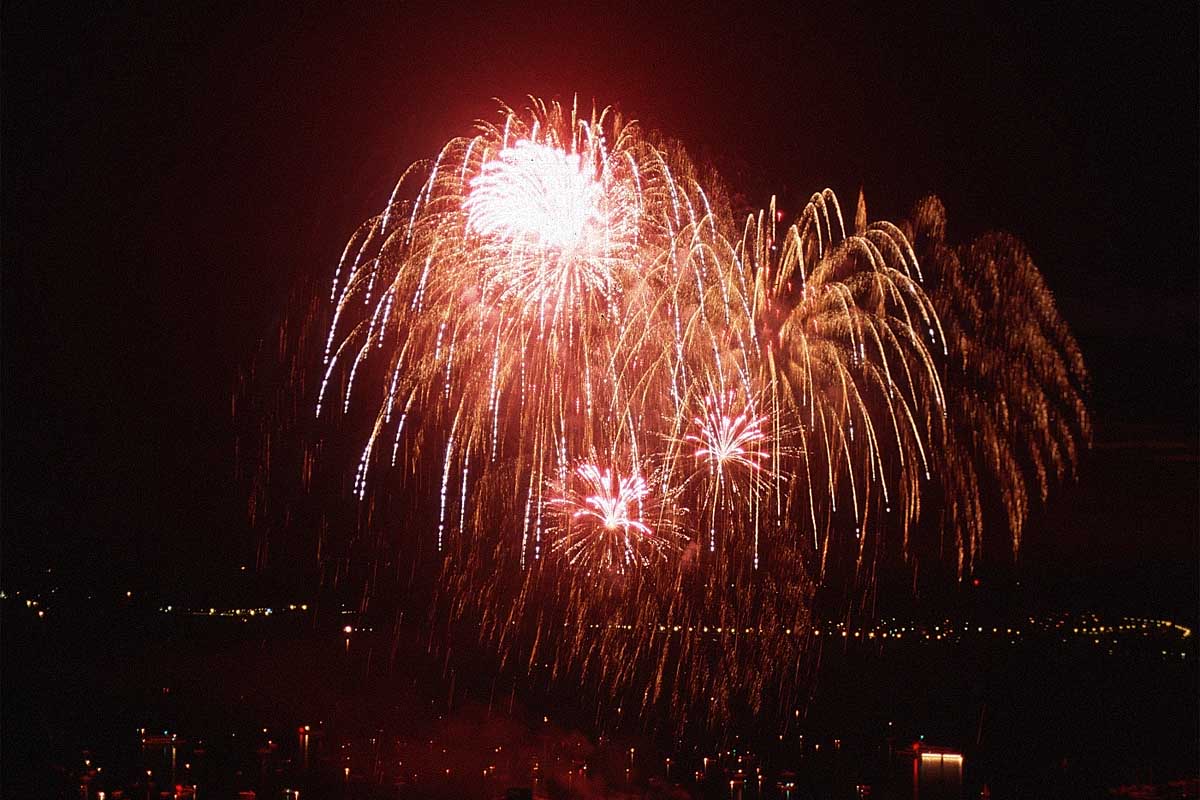
FireWorks photos

Make Unique Fireworks Photos Using Focus Blur

An interesting technique to help liven up your images from this summer's fireworks displays.
image-pop fireworks blur main

For Americans, July 4th is the night for dazzling displays of roman candles and Catherine wheels. We Australians have a similar opportunity every January 26, Australia Day. I've always been thrilled at the holiday's fireworks, but my pictures of the displays? Not so much.

Then I started playing with focus blur, an awesome technique that's perfect for capturing fireworks as well as other after-dark extravaganzas such as holiday lights.

Similar to the shooting technique of zoom blur—opening the shutter and zooming through the focal length settings of your lens for a kaleidoscopic effect—focus blur requires rotating your focusing ring during long exposures. The result: Part of the firework's arc or shape is sharp, and part morphs into a puff of defocused light and color.

By altering the speed, amount, and direction of the focus shift (from sharp to soft and back, or vice versa), you can produce a stunning and almost unlimited variety of visual effects.

Not all your focus blurs will be keepers.

Lets Party

Lets Party
Description: Finalist - Better Photo Contest


Celebrating !

Celebrating !
Description: Dusk by the charles river

like feathers in the sky!

like feathers in the sky!
Description: Fireworks, taken during 4th of July weekend in Athens, GA

Malta Feast

Malta Feast
Description:
Msida Church situated exactly opposite the seafront in Malta's leading port. A typical maltese celebration.

A Special dedication to a new friend and last month's Grand Prize Winner - Milan Banik.

The Big Bang

The Big Bang
Description: Its Celebration time in a Maltese Festa. Taken during the Santa Maria festivities in August.

Fourth of July

Fireworks 2

Fireworks
Description: Downtown Portland, OR 7/4/2006. Minor adjustments in Photoshop

Happy New year !

Happy New year !

New Year at Seattle Center (#1)

New Year at Seattle Center (#1)
Description: New Year 2007 at Seattle Center and the Space Needle, as seen from Kerry Park


Bringing In The New Year

Bringing In The New Year
Description:
Taken in Las Vegas at midnight on New Year's eve - ISO 200 - f20 - SS 2.5 seconds on manual, mounted on a tripod - focal length 70mm - The wind was blowing, giving it the feathery look.

Fireworks Show

Fireworks Show
Description: Taken at a pyrotechnic show on 13 Jan 2007 at the Mall of Asia, Pasay City, Philippines.

Fire Flowers

Fire Flowers
Description:

This is a six shot merge of some images taken during the 2005 Portland, Oregon fireworks display.

The pyrotechnics are launched from a barge located in the center of the Columbia river between Oregon and Washington. I was sitting on the south bank, right on the water with a tripod and a remote shutter release.

A July 2007 Editors First Pick and a BetterPhoto Members Favorite. Also listed in the Fireworks Pictures area of BetterPhoto.

Fireworks

Fireworks
Description: Lens: FA 45mm f/2.8

*the great ship 2*

*the great ship 2*
Description: the enclosed shot is of the great ship "queen mary" here in long beach california ,during the new year fireworks display.

Happy 10th Anniversary BP

Happy 10th Anniversary BP
Description: Thank you Maria Sacha for the suggestion take the Text out I still keep the other one since it was creted special for BP but Entering this one with out .this was comp 10 shot of my last yr fireworks.

Golden gate's golden night.

Golden gate's golden night.
Description: San Francisco, CA, USA.

Fireworks Celebration Over The Space Needle

Fireworks Celebration Over The Space Needle
Description: Taken from Queen Anne of the Space Needle in Seattle
Keywords: fireworks, seattle, space needle, city, night, celebration, washington, cityscape, queen anne, red, firework, nighttime, pink, purple, gold, horizontal, lights, black, blue, brown, celebrate, white, skyline, skyscrapers,

MS-1529


Description: Grand Palace on the King's birthday, Bangkok, Thailand

MS-2503


Description: Statue of Liberty, New York

Fourth of July


Description: Fireworks from the Marin Headlands in San Francisco, CA

*the great ship 2*


Description: the enclosed shot is of the great ship "queen mary" here in long beach california ,during the new year fireworks display.

Flowers of Fire


Description: what could better caracterize ENERGY than fireworks?

Happy 10th Anniversary BP


Description: Thank you Maria Sacha for the suggestion take the Text out I still keep the other one since it was creted special for BP but Entering this one with out .this was comp 10 shot of my last yr fireworks.

American New Year Celebration


American New Year Celebration

Golden gate's golden night


Description: San Francisco, CA, USA.

Fireworks Celebration Over The Space Needle


Description: Taken from Queen Anne of the Space Needle in Seattle
Keywords: fireworks, seattle, space needle, city, night, celebration, washington, cityscape, queen anne, red, firework, nighttime, pink, purple, gold, horizontal, lights, black, blue, brown, celebrate, white, skyline, skyscrapers,